
Introduction
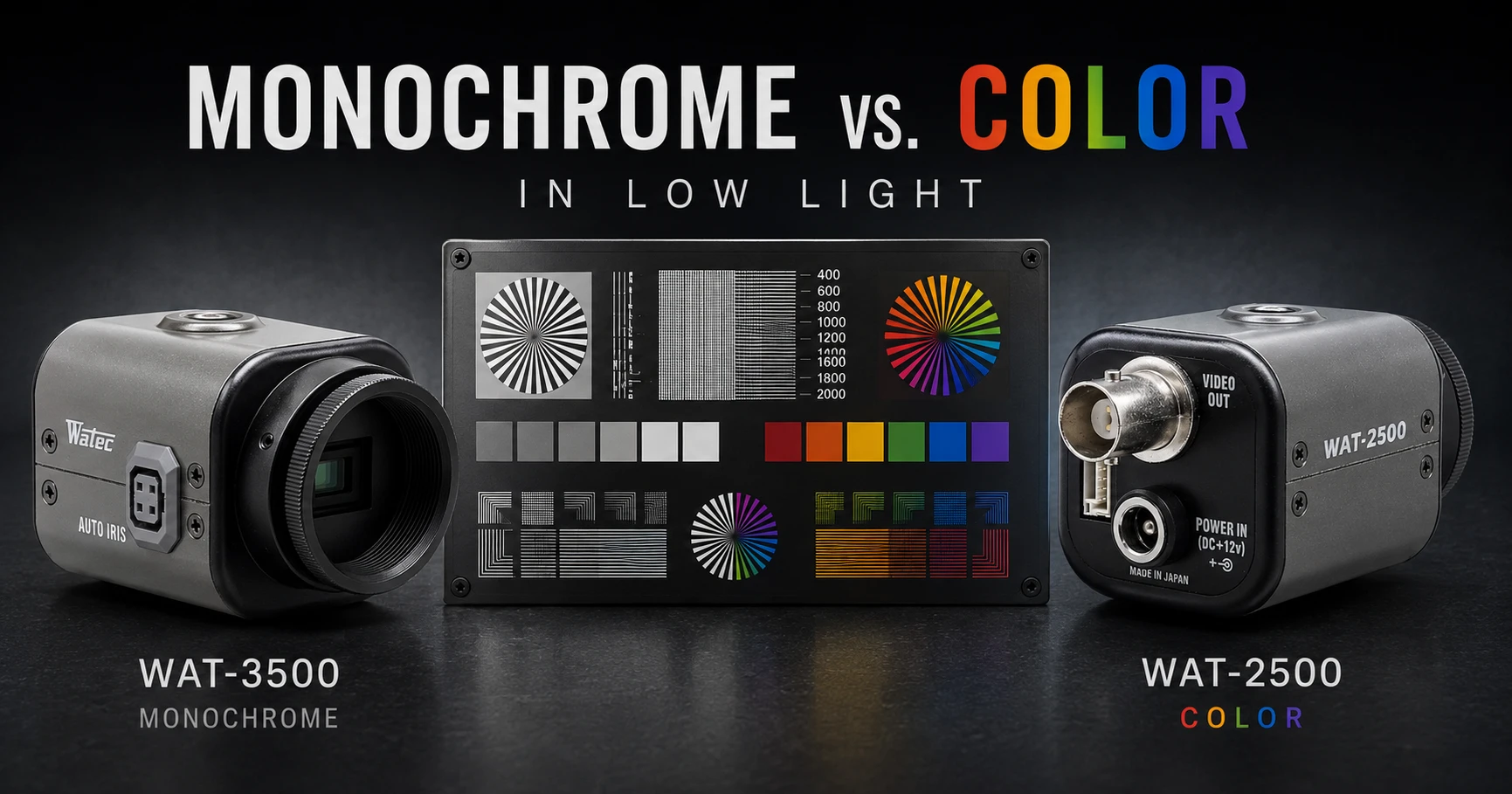
A technical look at monochrome versus color imaging, using the WAT-3500 and WAT-2500 to explore how sensitivity, color information, and low-light performance influence camera selection.
When illumination begins to fall, choosing between a color and monochrome camera becomes more than a matter of visual preference.
A color camera preserves chromatic information that may be essential for identification, documentation, or analysis. A monochrome camera does not reproduce color, but it may provide greater sensitivity when the available light becomes extremely limited.
The question, therefore, is not simply: Which camera is better?
The more useful question is: What information must the imaging system continue to capture as the light disappears?
The Watec WAT-2500 and WAT-3500 provide an especially useful comparison. The cameras share many important specifications, including sensor size, effective pixel count, unit-cell size, output type, body dimensions, and image-control functions. Their primary distinction is the type of information they are designed to preserve: color from the WAT-2500 and high-sensitivity monochrome imagery from the WAT-3500.
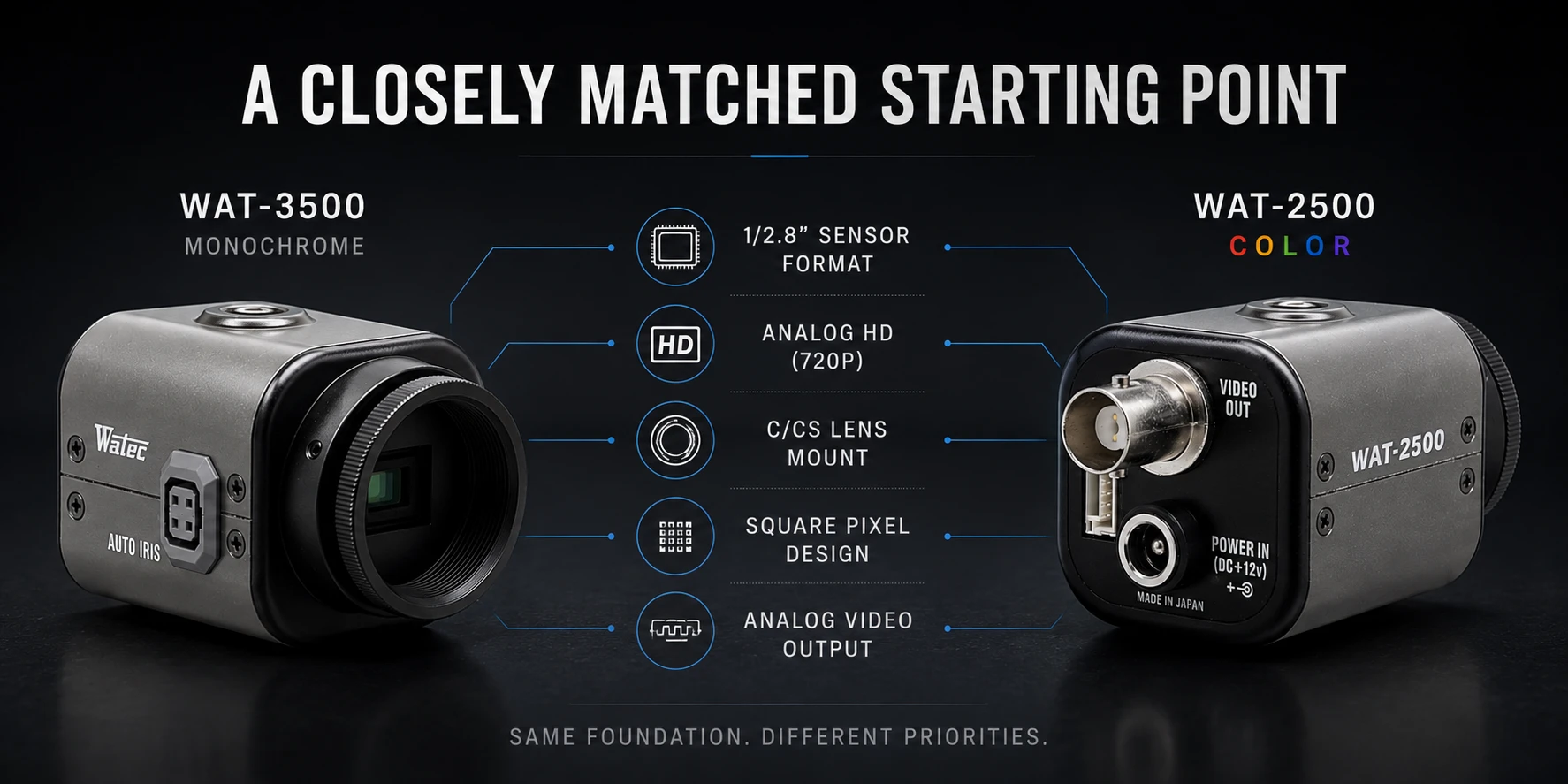
A meaningful comparison begins by identifying what the two cameras have in common.
Both the WAT-2500 and WAT-3500 use a 1/2.8-inch CMOS image sensor with 1945 × 1097 effective pixels and a unit-cell size of 2.9 µm × 2.9 µm. Both use progressive scanning and provide composite analog video through a 1.0 Vp-p, 75-ohm unbalanced output. Each is specified at more than 570 TV lines of horizontal resolution at the center of the image.
Their physical designs are also closely related. The mechanical drawings show approximately 34 mm square bodies and an overall body length of about 50 mm. Both use a CS lens mount with adjustable back focus and include 1/4-20 mounting provisions. The WAT-2500 weighs 79 grams, while the WAT-3500 weighs approximately 78 grams.
That similarity matters.
This is not a comparison between two entirely different camera formats. It is a comparison between two compact analog cameras with closely matched packaging, resolution, pixel dimensions, output, and system controls—but with different imaging priorities.
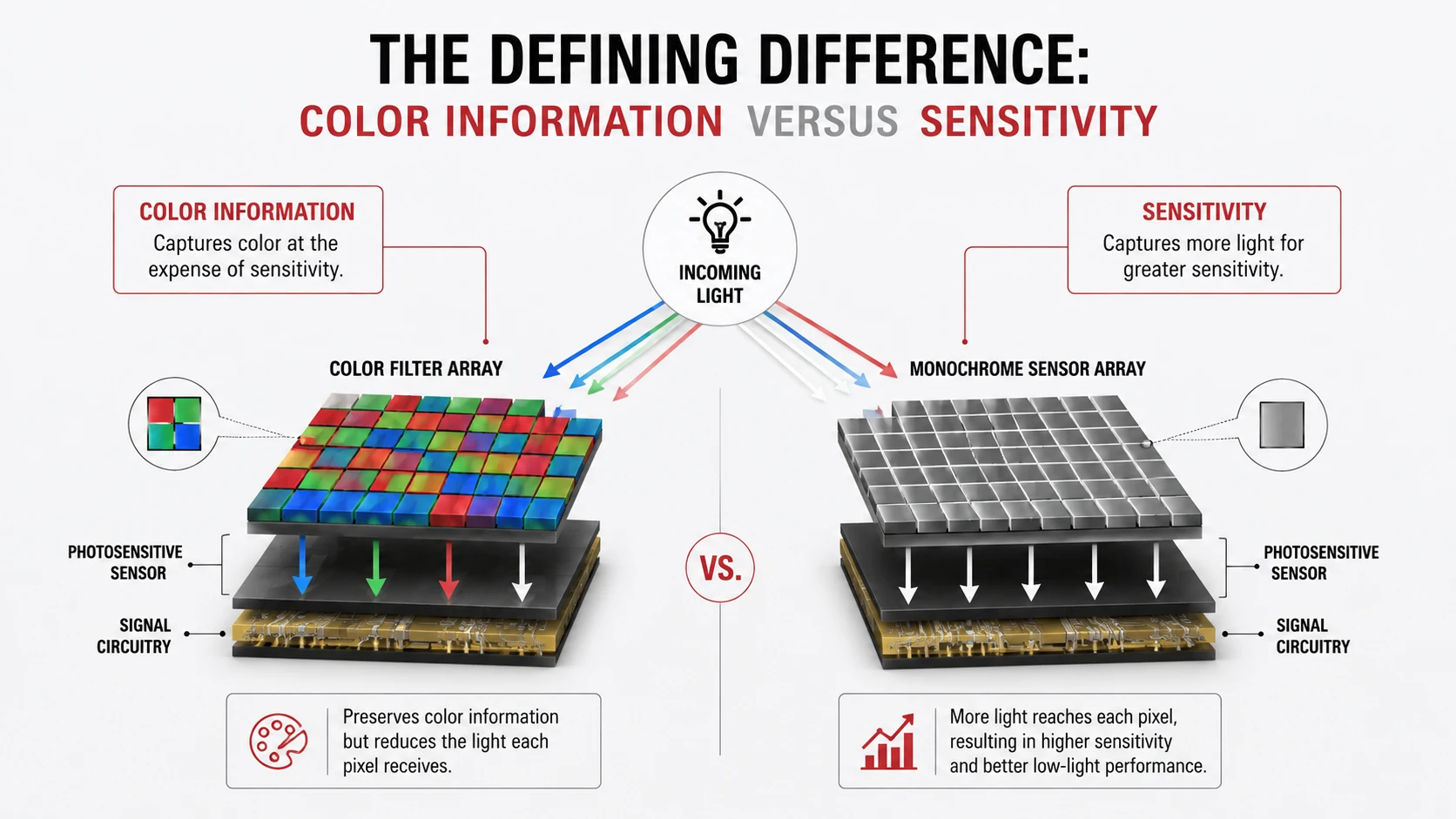
The WAT-2500 specification identifies an RGB primary-color Bayer mosaic filter on the image sensor. That color-filter arrangement enables the camera to distinguish red, green, and blue information and produce a color image. The camera also provides automatic tracking white balance, preset white balance, and manual white balance controls.
The WAT-3500, by contrast, is designed as a black-and-white camera and uses a 1/2.8-inch back-side-illuminated CMOS sensor. Its purpose is not to reproduce color, but to provide high sensitivity in extremely limited illumination.
In general, a color imaging system must separate incoming light into color components before reconstructing the final image. A monochrome camera does not need to preserve or reconstruct that chromatic information. Instead, it records differences in luminance and tonal intensity.
That does not make monochrome universally superior.
It means each camera preserves a different kind of information:
- The color camera retains hue and color relationships.
- The monochrome camera prioritizes luminance information and low-light sensitivity.
The correct choice depends on which type of information the application requires.
What the minimum-illumination specifications show
The published minimum-illumination figures reveal the clearest difference between the two models.
With the shutter off and automatic gain set to its 72 dB high setting, the WAT-2500 is specified at:
0.0065 lx at F1.2
Under its published shutter-off condition, the WAT-3500 is specified at:
0.0001 lx at F1.4
The WAT-3500 therefore carries a substantially lower published minimum-illumination figure, even though the listed aperture in that comparison is narrower.
The specifications also list still-lower illumination levels when ×15 frame accumulation is enabled:
- WAT-2500: 0.0004 lx at ×15
- WAT-3500: 0.000007 lx at ×15
These values demonstrate the WAT-3500’s intended role as the more sensitive low-light option. However, a minimum-illumination number should never be read in isolation.
A lux value only becomes meaningful when considered alongside:
– Lens aperture
– Gain level
– Shutter or frame-accumulation setting
– Subject movement
– Acceptable noise
– The amount of detail the application must preserve
The lowest number on a specification sheet is not automatically the best operating condition for every system.
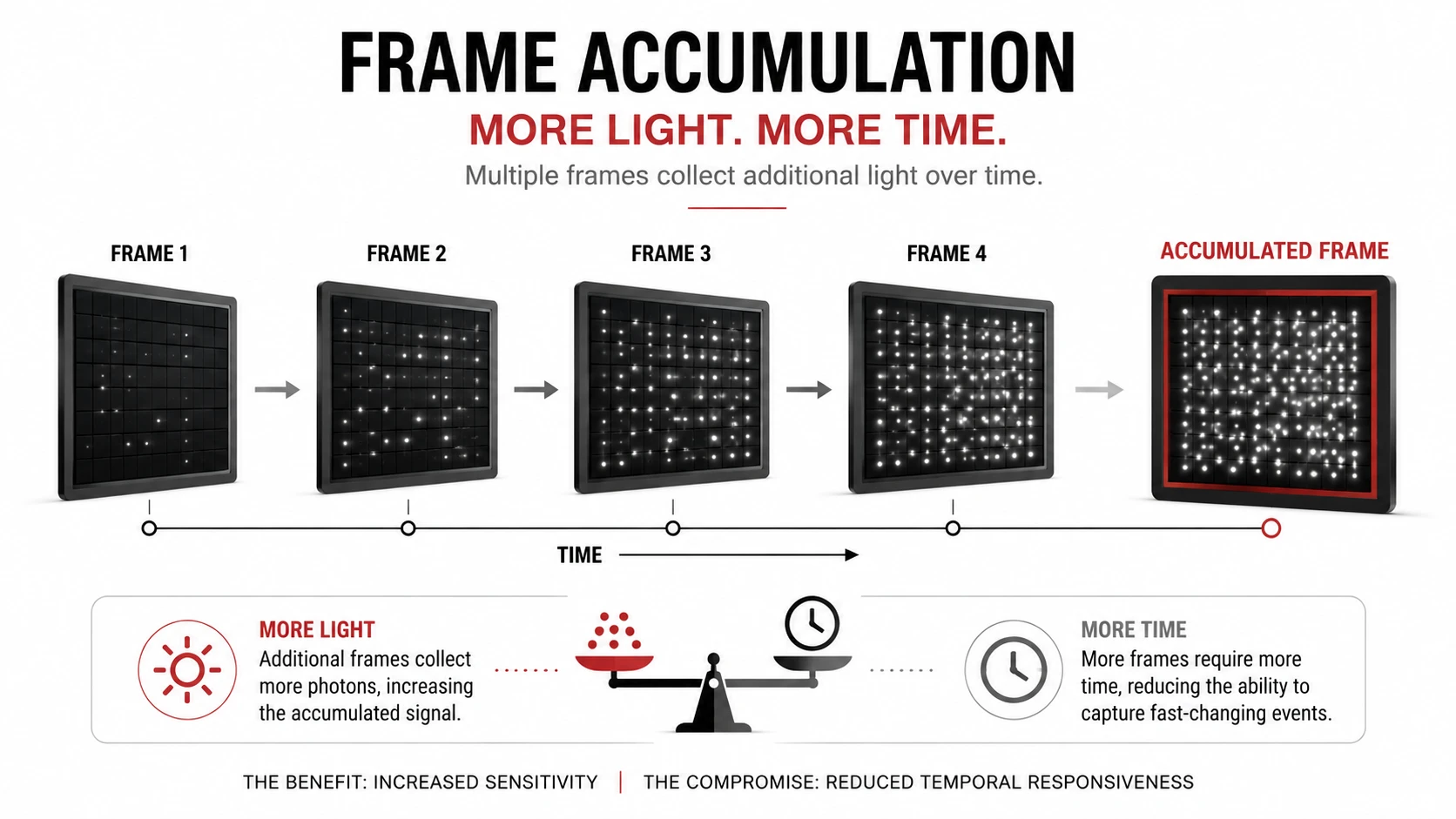
Both cameras support frame-accumulation settings from ×2 through ×15. Their lowest stated minimum-illumination figures are achieved at ×15.
Frame accumulation allows the camera to collect visual information over a longer effective period. In a static or slowly changing scene, that can make faint details more visible.
The tradeoff is temporal performance.
When the subject moves—or when the camera itself is moving—a longer accumulation period can reduce responsiveness and introduce motion blur. That means a setting capable of producing impressive visibility in a stationary scene may not be appropriate for:
- Moving vehicles
- Mobile surveillance platforms
- Robotics
- Rapid industrial processes
- Aerial systems
- Subjects that must be observed in real time
This is why the shutter-off figures deserve particular attention. They provide a useful reference for low-light performance without relying on the longest available accumulation setting.
Gain can brighten the image, but brightness is not the same as information
Both cameras offer automatic gain-control ranges of:
- 0–36 dB in LOW
- 0–50 dB in MID
- 0–72 dB in HIGH
They also provide manual gain from 0 to 72 dB in 5 dB increments.
Gain increases the amplitude of the camera’s electronic signal. It can make a dark image appear brighter, but it does not create new scene information. As gain rises, unwanted noise may become more visible along with the desired signal.
Both models include adjustable 2D noise reduction, 3D noise reduction, and combined 3D-plus-2D noise reduction. They also provide adjustable gamma and sharpness.
These controls give the integrator substantial flexibility, but they also reinforce an important principle:
In low-light imaging, the goal is not simply to produce the brightest possible picture. The goal is to preserve usable visual information.
Noise reduction can make an image appear cleaner. Sharpness can make edges appear more pronounced. Gain can increase brightness. But none of those settings can restore information that the sensor never captured.
Signal-to-noise ratio adds another layer to the comparison
The WAT-2500 is specified at more than 50 dB signal-to-noise ratio with automatic gain off, gain at 0 dB, and gamma at 1.0.
The WAT-3500 is specified at more than 45 dB under the same stated gain and gamma conditions.
This is a useful reminder that camera selection cannot be reduced to one specification.
The WAT-3500 has the substantially lower published minimum-illumination figures. The WAT-2500 lists the higher signal-to-noise specification under the stated baseline condition.
Sensitivity, noise, color fidelity, motion handling, and usable detail must therefore be considered together.
A camera can be more sensitive in extremely low light without being the automatic choice for every scene. Likewise, a camera with a higher stated signal-to-noise ratio may still require substantially more illumination to produce a usable image.
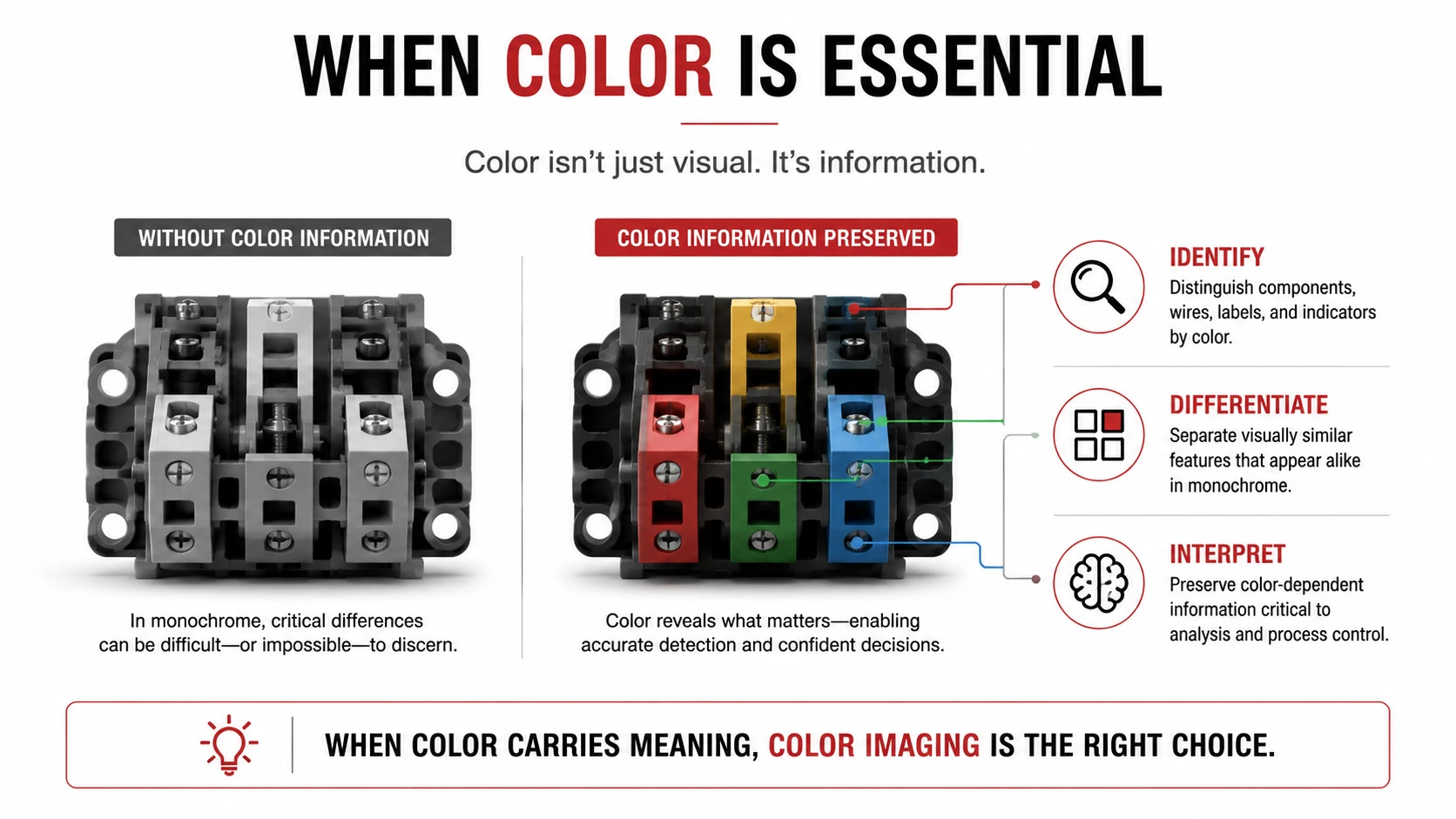
The WAT-2500 is the stronger starting point when hue itself is part of the information the system must capture.
Color may be important for:
- Identifying wires, labels, or markings
- Differentiating materials or components
- Recognizing indicator lights
- Recording color-based conditions
- Preserving situational context
- Supporting human interpretation and documentation
A monochrome camera cannot retain information that exists only as color. If two objects have similar brightness but different hues, those differences may be much easier to distinguish in a color image.
For those applications, the WAT-2500’s RGB Bayer imaging system and white-balance controls provide capabilities the monochrome camera is not intended to deliver.
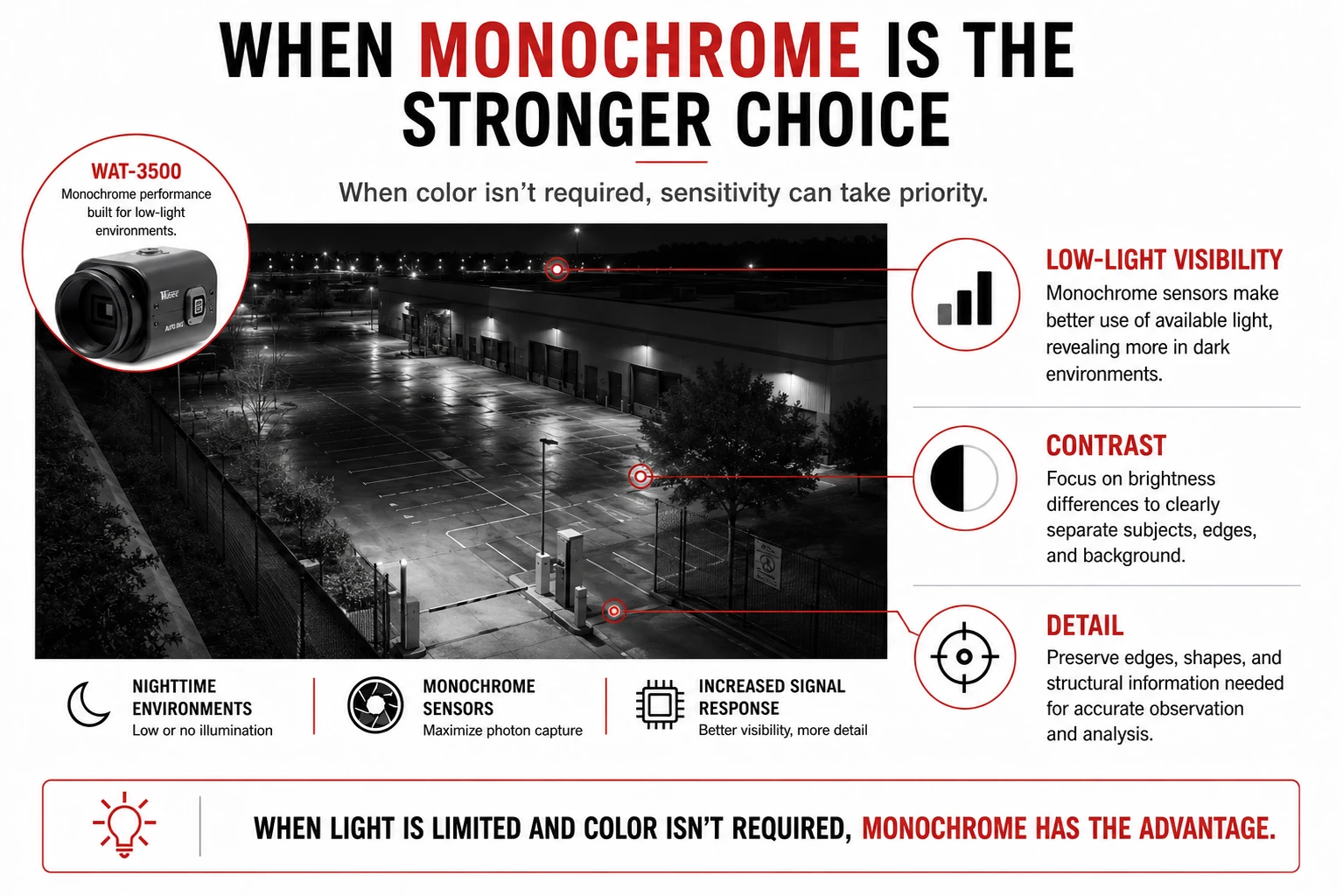
The WAT-3500 is designed for applications in which very high sensitivity is more important than color reproduction.
It may be the stronger starting point when the task depends primarily on:
- Shape
- Edges
- Tonal contrast
- Presence or absence
- Movement
- Structural detail
- Observation under extremely limited illumination
When color does not contribute meaningfully to the task, a monochrome image may provide the visual information the system needs at much lower published illumination levels.
That makes the WAT-3500 particularly relevant when available light is the dominant system constraint.
Similar hardware does not mean identical purpose
Because the two cameras share such similar dimensions and mechanical layouts, the selection decision may be driven less by packaging and more by the imaging requirement.
Both provide:
- Compact 34 mm-class bodies
- Analog composite output
- CS-mount lens compatibility
- Adjustable back focus
- DC auto-iris support
- Remote OSD configuration
- WDR and digital WDR
- BLC and HSBLC
- Defog
- Adjustable noise reduction
- Up to ×6 digital zoom
- Image flip and privacy-mask functions
That allows an engineer or system integrator to begin with a broadly similar physical and operational platform, then choose the model according to the type of information the system must capture.
A practical selection framework
Consider the WAT-2500 when:
- Color identification is required.
- Hue is part of the measurement or observation.
- The image must preserve natural color context.
- Available illumination is sufficient for the required shutter and gain settings.
Consider the WAT-3500 when:
- Maximum low-light sensitivity is the priority.
- Tonal and structural detail matter more than hue.
- The application operates in extremely limited illumination.
- Color information is not necessary for the task.
For either camera, also ask:
- Is the subject moving?
- Can the application tolerate frame accumulation?
- What lens aperture will be used?
- How much gain is acceptable?
- What level of noise can the application tolerate?
- Does the image need to support human observation, automated analysis, or both?
Choose the information the system needs
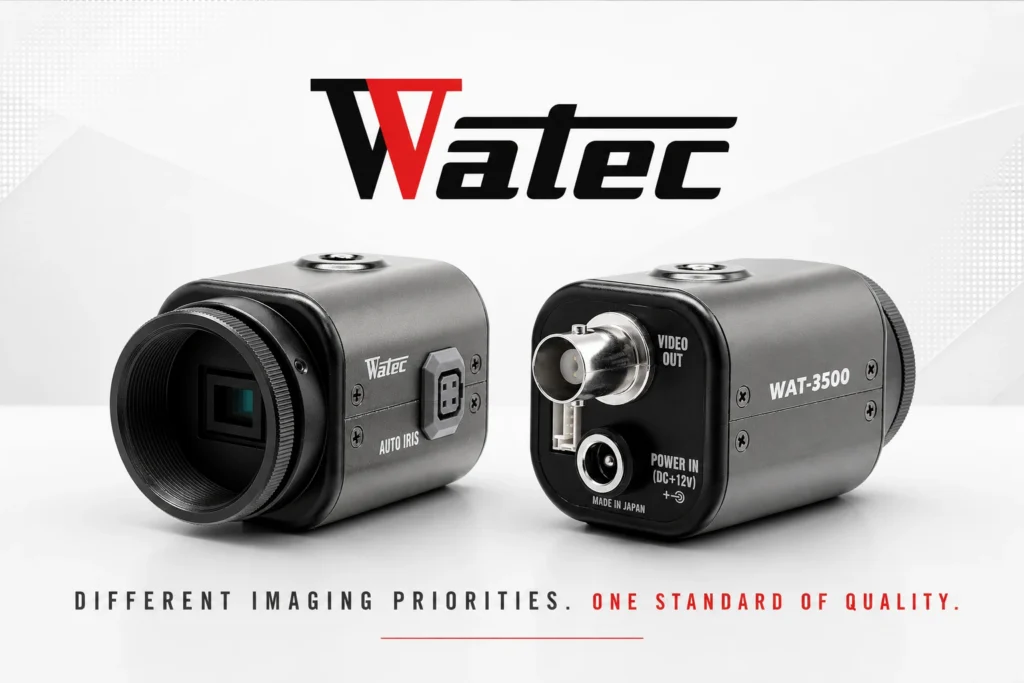
The WAT-2500 and WAT-3500 share a closely related camera platform, but they are engineered to preserve different kinds of visual information.
The WAT-2500 retains color data that may be essential for identification, classification, and documentation.
The WAT-3500 prioritizes sensitivity when illumination becomes extremely limited.
Neither approach is universally better.
The right camera is the one that continues to reveal the information the application actually needs—under the lighting, motion, optics, and operating conditions the system will encounter.
Because in low-light imaging, the most important specification is not simply how dark the scene can become.
It is whether the camera can still capture what matters.
Contact our Decatur–Huntsville support team today or request a personalized quote: (888) 567-4294